
A novel field method for assessing bumblebee welfare
May 1, 2026
“The idea that insects could be deserving of welfare considerations is something I don’t think comes naturally to us as humans,” says Vivek Nityananda, Senior Lecturer at Newcastle University. “But if any insect could generate the same recognition of similarity that humans have with mammals, it would maybe be bumblebees.”
Vivek has devoted his career to studying insects’ sensory capacities, from sound perception in bush crickets to vision in praying mantises. When he started his own lab, he began to wonder if he could study their welfare, too.
Insect sentience is uncertain territory, but bees exhibit several behaviors that are often used as indicators of potential sentience in invertebrates. In fact, they exhibit more of these behaviors than several other invertebrate taxa.
Vivek is particularly interested in bees’ affective states. With funding from a Wild Animal Initiative Challenge Grant, he and postdoctoral researcher Sarah Scott are conducting the first study of the affective states of wild bumblebees, and how they’re affected by different environmental factors.
Are bees optimists?
Affective states in animals are often measured using judgment bias tests, in which an animal is trained to associate one stimulus with a reward, and another with a neutral or negative outcome. Once trained, the animal is tested with a new, ambiguous stimulus. An animal is understood to have an optimistic bias if they interpret uncertainty positively — that is, if they assume the ambiguous stimulus will lead to a reward and respond accordingly. Negative interpretation of uncertainty, meanwhile, indicates a pessimistic bias. These cognitive biases are taken to be markers of good and poor welfare, respectively.
Researchers using these tests have observed pessimistic biases in physically stressed honeybees and bumblebees, shown that honeybees become more pessimistic as they age, and revealed that optimistic bees spread their optimism to conspecifics. But these results come from studies of commercially-bred bee colonies living in laboratories, so they don’t necessarily help us understand the welfare of free-ranging bees. “Bumblebees contend with so many different factors in their lives in the wild,” Sarah says. “You can’t even begin to replicate that in the lab.”

Vivek Nityananda, Senior Lecturer at Newcastle University in the UK, is studying bumblebee welfare at a range of sites in North East England, supported by a Wild Animal Initiative Challenge Grant. Photo courtesy of Vivek Nityananda.
That’s why Vivek and Sarah are developing a judgment bias test for bumblebees that can be performed in the wild. Their test takes place in a centrifuge tube, using color cues as the stimuli and a sugar solution as the reward. The goal of the project is to look for predicted markers of poor welfare in bees whose habitats are predicted to induce it.
Staring at bees
“We don’t know anything about the challenges wild bumblebees might face because their welfare hasn’t really been measured — especially in the wild,” Vivek says. But, as he is the first to admit, “lack of knowledge never stops scientists from speculating.” He and Sarah hypothesize that pollution, land-use intensity, competition with other species, pesticide exposure, disease, soil chemistry, and predation might all affect wild bees’ welfare.
Fieldwork is Sarah’s domain, taking place at three distinct sites near the city of Newcastle upon Tyne in North East England, where Newcastle University is based. The predicted high-stress/low-welfare habitat is a park in the city that is exposed to relatively high levels of pollution and offers comparatively little in the way of nutrition for bees. Field sites two and three are in predicted lower-stress/higher-welfare habitats: a working research farm owned by the university, and a site in Northumbria National Park.
“We developed a judgment bias test travel kit where we could pack up everything in a backpack and take it out into the field,” Sarah says. “It’s a lot of me sitting and staring at the bumblebees, hoping they actually do what I want them to do.”
She has stared at a variety of bees so far. Buff-tailed, white-tailed, common carder, garden, and early bumblebees have all paid visits to the centrifuge tube — along with the occasional, invariably reluctant red-tailed bumblebee. (She says that for reasons known only to them, red-tailed bumblebees “are just so against participating” in the experiment.)
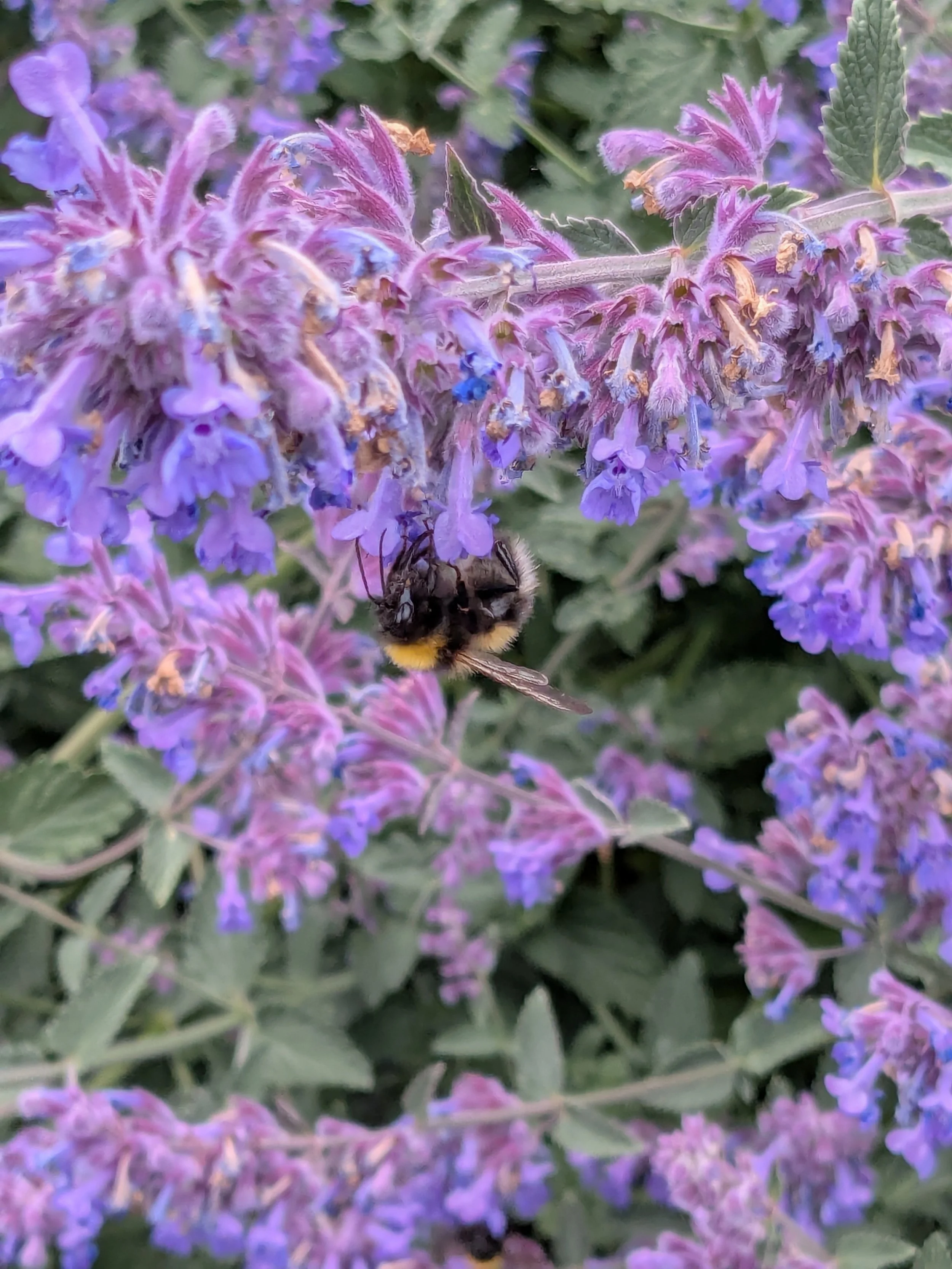
A buff-tailed bumblebee (Bombus terrestris) investigates some catmint flowers. Photo courtesy of Sarah Scott.
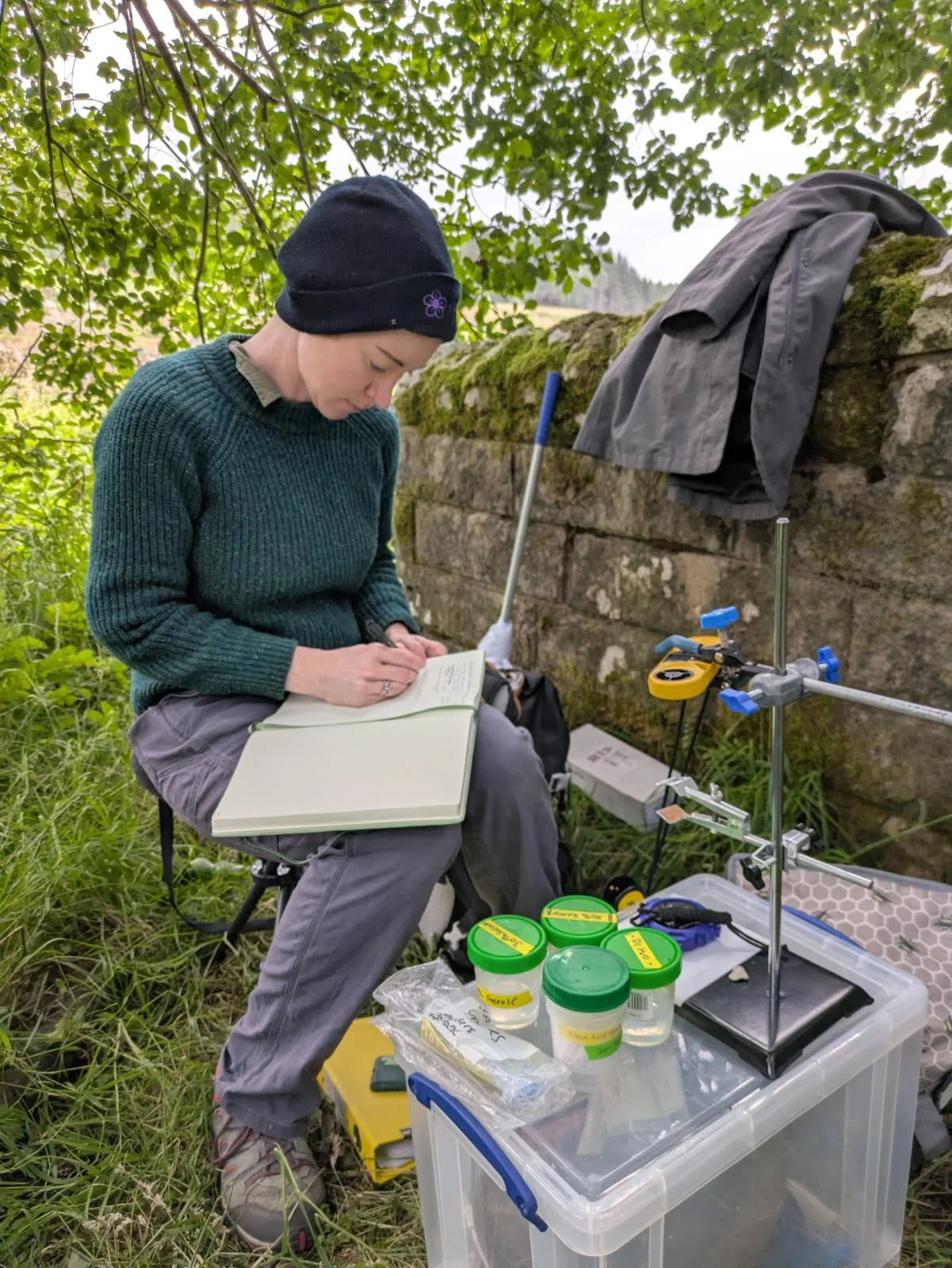
Postdoctoral researcher Sarah Scott sits with the portable judgment bias test kit and takes notes. Photo courtesy of Sarah Scott.
Vivek and Sarah plan to combine the judgment bias test with measurements of how the bees respond to rewards — namely, feeders containing a sugar solution. Animals experiencing a depression-like state typically respond less enthusiastically to rewards than do those with positive affective states. Together, these two indicators can tell us at which of these study sites the bees seem to have better or worse welfare, with the assumption that environmental variables at the sites are probably highly relevant to the results. If future researchers are able to replicate the study’s results, we’ll be able to learn something about what kinds of environments contribute to better and worse welfare for wild bumblebees.
Spreading a message
The number of insects living in the wild dwarfs all classes of vertebrate species by orders of magnitude, so if insects are sentient, understanding their lived experiences would be a top priority for those wishing to improve the lives of as many wild animals as possible.
Our current understanding of wild insects’ affective states is limited by lack of research — itself impeded partly by a lack of tools. Along with the short-term impact of producing knowledge about which environments contribute to different welfare states in wild bumblebees, the tests that Vivek and Sarah are developing could be used by future researchers to study the welfare of a range of other wild insects.
There are a staggering 10 million insect species estimated to be living in the wild, few with as much charisma as bees. It’s precisely that charisma that may make bees a good starting point for insect welfare research. “Bees have a lot of cultural clout,” Vivek says, so studies like this are “perhaps a good way of using them to spread a broader message.”