

Library
Browse resources published by our research team.
In addition to full texts of our peer-reviewed articles, our library includes research digests that break down our peer-reviewed articles; in-depth reports that thoroughly examine a topic; commentaries that explain the significance of particular issues in wild animal welfare science; and short communications that briefly survey a field or topic.
Wild Animal Initiative adheres to Open Science TOP Guidelines. Read more here.
Bye-bye bycatch: a remotely closing trap for targeted songbird capture
Bonnie Flint, Ben Vernasco
Flint, B. F., & Vernasco, B. J. (2025). Bye-bye bycatch: a remotely closing trap for targeted songbird capture. Journal of Field Ornithology, https://doi.org/10.5751/JFO-00744-960408
Authored by Wild Animal Initiative’s Researcher and Education Specialist, Bonnie Flint, this paper was published in the December 2025 issue of the Journal of Field Ornithology.
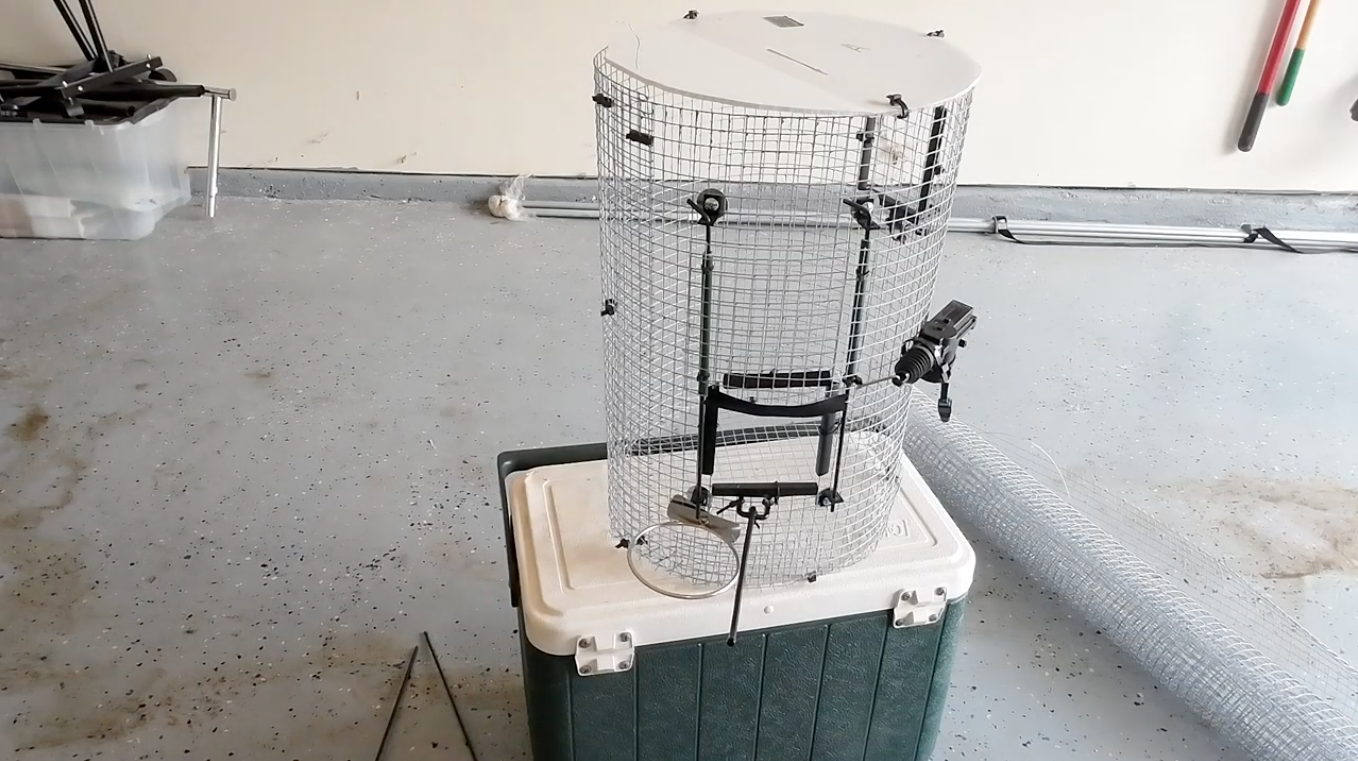
About the paper
This remotely closing bird trap was designed as part of our house sparrow research project, which aims to validate indicators of welfare in house sparrows and examine how varying environmental conditions affect their welfare.
Capturing and marking animals is often an essential component of studying wild populations, but the process of capturing and marking can have detrimental effects on captured birds. For instance, research projects are often focused on one or a few species, yet many other, non-target species can be inadvertently captured. Bycatch (non-target animals that are captured during the process of capturing target animals) is a frequent problem in ornithological research projects using non-selective capture methods such as mist nets, Potter traps, or other passive, baited traps. These non-target individuals likely suffer negative welfare implications from being caught (with potential effects on their health and fitness), and researchers may waste valuable time and resources processing bycatch for release when they could be focusing on capturing and collecting data from target species. To remedy this problem, we introduce here a relatively simple trap design that installs on a bird feeder and traps birds using a wireless, remotely closing door to allow selective capture of birds visiting a feeding station, a common capturing context in ornithological studies. We describe how to construct the selective, remotely closing trap and report our experience using the traps to selectively capture house sparrows (Passer domesticus) in comparison to mist nets. This easy-to-use trap will benefit researchers looking to effectively and efficiently capture target species while also decreasing bycatch and will be especially convenient at established bird feeding stations.
This is the first in a series of papers that we expect to result from the house sparrow project. Future papers resulting from the project will focus directly on indicator validation and house sparrow welfare.
Visit our blog to read about our progress on the house sparrow project:
Research sense: Incorporating animals’ sensory capacities in animal care and study design
Mal Graham, Bob Fischer
Graham M., Fischer B. (2026). Research sense: Incorporating animals’ sensory capacities in animal care and study design. Laboratory Animals. 2026;60(2):220-224. https://doi.org/10.1177/00236772251385784. (First published online December 14, 2025.)
Co-authored by Wild Animal Initiative Strategy Director Mal Graham, this paper was first published online in Laboratory Animals in December 2025.
Abstract
No systematic procedures exist to ensure that differences in animal sensory capacities are accounted for in experimental design and ethical review processes. This oversight can compromise both scientific validity and animal welfare. This review presents three practical methodologies to address this gap: incorporation of specialist expertise through consultation frameworks, voluntary certification schemes modeled on Open Science practices, and mandatory sensory capacity review integrated into existing ethics committee processes. We provide a concrete tool — a sensory modality survey — that can be implemented by institutional review committees to evaluate sensory considerations in research proposals systematically. These approaches align with the 3Rs principles by enhancing experimental refinement and potentially reducing animal use through improved study design.