

Meet our grantees
Wild Animal Initiative funds academic research on high-priority questions in wild animal welfare.
The goal of our grants program is to fund research that deepens scientific knowledge of the welfare of wild animals in order to better understand how to improve the welfare of as many wild animals as possible, regardless of what causes the threats to their well-being.
We showcase our grantees and their projects here and continuously update this page as new projects are added.
Improving the welfare of wild and captive animals with integrated in-situ and ex-situ behavioural monitoring
Grantee: Sarah Richdon
Institution: Bristol Zoological Society
Project summary
This project will investigate the welfare impacts of translocating captive-bred white-clawed crayfish (Austropotamobius pallipes) into an existing wild population. Both resident and introduced individuals will be fitted with transponders and marked for behavioral monitoring. To evaluate welfare, the researchers will observe social interactions (e.g. aggressive interactions), behavioral diversity, and the animals’ use of their habitat. For example, emigration of native individuals from the focal habitat may be indicative of intraspecific competition intensified by the translocation. Body condition will also be scored as a metric of health and resource access.
Grantee: Sarah Richdon
Institutions: Bristol Zoological Society, United Kingdom
Project start date: April 2024
Grant amount: $30,000
Grant type: Seed grants
Focal species: White clawed crayfish (Austropotamobius pallipes)
Conservation status: Endangered
Disciplines: Animal welfare science, marine biology
Research location: United Kingdom
Project summary
This project will investigate the welfare impacts of translocating captive-bred white-clawed crayfish (Austropotamobius pallipes) into an existing wild population. Both resident and introduced individuals will be fitted with transponders and marked for behavioral monitoring. To evaluate welfare, the researchers will observe social interactions (e.g. aggressive interactions), behavioral diversity, and the animals’ use of their habitat. For example, emigration of native individuals from the focal habitat may be indicative of intraspecific competition intensified by the translocation. Body condition will also be scored as a metric of health and resource access.
Why we funded this project
We are excited to fund a project focused on the welfare of invertebrates, in this case an aquatic crustacean. The monitoring methods and some findings of this project may also be applicable to other aquatic taxa. Translocation is already a commonly used intervention in conservation, yet its welfare implications are poorly understood. By learning about these, translocation strategies could potentially be improved, and we might gain insights that could be applied to other welfare-motivated interventions.
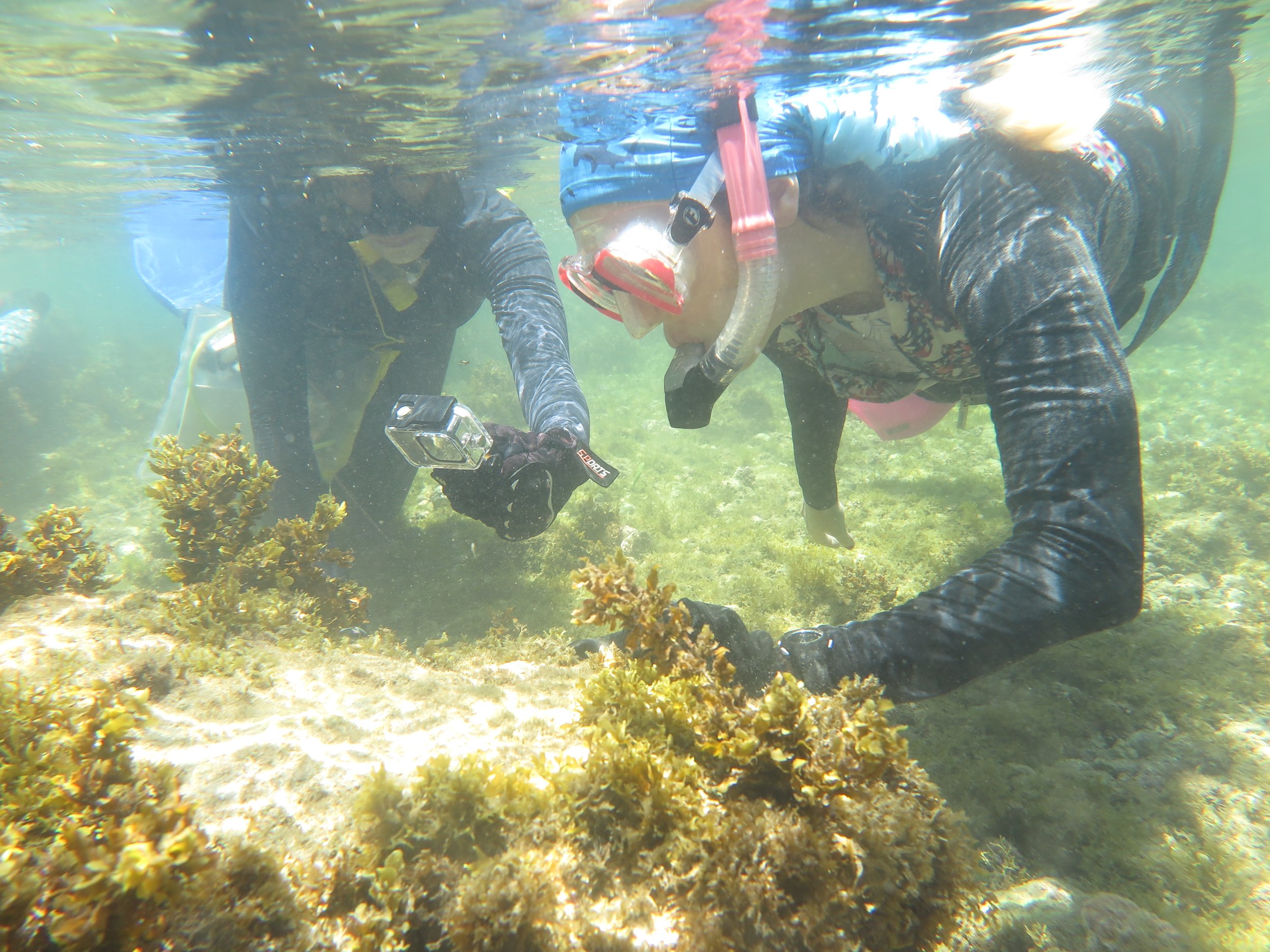
Development of octopus mind in the wild: a behavioral, ecological and evolutionary investigation into sentience and emotional states in Octopus insularis juveniles
Grantee: Michaella Andrade
Institution: Federal University of ABC
Project summary
There is evidence that evolutionary pressures can cause behaviors with opposite meanings to develop opposite forms, the way a frown is the opposite of a smile. One way to understand the expression of emotion in animals may therefore be to identify pairs of behaviors that are opposites. In octopuses, which are increasingly being recognized as sentient, colors can be signals of emotional valence during conflict and other situations. Yet no study has tested whether octopuses have opposite pairs of color signals. This project will produce descriptions of evolutionary and behavioral patterns that reflect the emotional states and sentience of juvenile octopuses, which may contribute to the welfare of octopuses and other invertebrates.
Grantee: Michaella Andrade
Institution: Federal University of ABC, Brazil
Project start date: April 2022
Grant amount: $37,959
Grant type: Challenge grants
Focal species: Octopuses (Octopoda sp.)
Conservation status: Data deficient
Disciplines: Sentience, animal behavior
Research location: Brazil
Publications
Andrade M.P., et al. (2023). Assessing Negative Welfare Measures for Wild Invertebrates: The Case for Octopuses. Animals, 13(19), 3021. https://doi.org/10.3390/ani13193021
Project summary
Welfare refers to the quality of life of animals that possess sentient capacity and emotional states. Although the precursors of sentience were possibly present on the planet as early as 890 million years ago, the evolution of sentience is still poorly understood. However, cephalopods are increasingly being recognized as sentient, yet we do not know about this phenomenon in juvenile wild animals. In this sense, studies with wild animals can be beneficial for finding a wider range of ecological triggers and their relationship with behaviors.
There’s evidence that evolutionary pressures can cause behaviors with opposite meanings to eventually develop opposite forms, the way a frown is the opposite of a smile. One way to understand the expression of emotion in animals therefore may be to find pairs of behaviors that are opposites. In octopus, colors can be a signal of emotional valence during conflict and other contexts. Although researchers began to see this dimension in octopuses, no study has tested whether opposite pairs of color signals are present in octopuses. This project will produce descriptions of evolutionary and behavioral patterns that reflect the emotional states and sentience for juvenile octopuses, which may contribute to the welfare of octopuses and other invertebrates.
Why we funded this project
Although octopuses are widely assumed to be sentient at the adult stage, no studies that we are aware of have examined sentience at earlier life stages. As the vast majority of octopuses alive at any one time are juveniles, and octopuses have enormously high juvenile mortality, the question of when in their development sentience arises is particularly important. This project is also interesting because it will teach us about what the lives of juvenile octopuses are like and the extent to which welfare effects are mediated by personality traits.
Photos


Improving the welfare of farmland invertebrates
Grantee: Dr. Ruth Feber
Institution: University of Oxford
Project summary
In Lepidoptera (butterflies and moths), larvae are much more abundant and less mobile than adults. Larvae are therefore particularly vulnerable to negative stimuli, including starvation and disease. This project will use lepidopteran larvae as a model for auditing the welfare impact of agricultural activities on invertebrates. Juvenile stages of Lepidoptera are exposed to agricultural practices that have the potential to affect their welfare. To quantify these impacts, the study will extend the Quality Adjusted Life Year (QALY) methodology to take into account the number of individuals affected by a specified action.
Grantee: Dr. Ruth Feber
Institution: Wildlife Conservation Research Unit, Recanati-Kaplan Centre, Department of Zoology, University of Oxford, United Kingdom
Project start date: May 2022
Grant amount: $58,448
Grant type: Challenge grant
Focal species: Butterflies (Rhopalocera sp.)
Conservation status: Near threatened
Disciplines: Entomology, population ecology, physiology
Research location: United Kingdom
Project summary
Invertebrates, particularly insects, often have complex life histories. Juveniles (which make up the overwhelming majority of invertebrate numbers) may experience a range of different life quality outcomes. In Lepidoptera (butterflies and moths), for example, adults are the most visible stage, but the much more abundant larvae are less mobile than adults and are particularly vulnerable to negative stimuli including starvation and disease.
This project will use lepidopteran larvae as a model for auditing the welfare impact of agricultural activities on invertebrates. Juvenile stages of Lepidoptera tend to comprise the largest proportion of the total lifespan in temperate regions and, as juveniles, they are exposed to a wide range of agricultural practices that have the potential to affect their welfare. Lepidoptera are also among the better-studied invertebrates, with published data on the ecology, life histories, and survivorship of some species. This knowledge will be used to help inform welfare impact assessments.
The study will adapt the Quality Adjusted Life Year (QALY) methodology to quantify the welfare impacts of agriculture, which has recently been adapted by Teng et al. (2018) to compare the impact of diseases of domestic animals with a Welfare Adjusted Life Year (WALY). This project aims to extend the QALY to take into account the number of individuals affected by a specified action.
Why we funded this project
Farms take up nearly half of the world’s habitable land, but there is a lack of research into how agricultural management practices might impact wild animals, especially invertebrates. In order to improve welfare for invertebrates, we first need to understand how to measure welfare. This project will explore a model to quantify wild insect health and well-being. We were especially attracted to this project because it will repurpose existing data, allowing the research objectives to be accomplished more cheaply and with less animal suffering than might otherwise be required. We were also excited by the PI’s interest in quantifying welfare using a QALY-like framework, which fits perfectly with our utilitarian approach and could lead to actionable policy recommendations.


