
Meet our grantees
Wild Animal Initiative funds academic research on high-priority questions in wild animal welfare.
The goal of our grants program is to fund research that deepens scientific knowledge of the welfare of wild animals in order to better understand how to improve the welfare of as many wild animals as possible, regardless of what causes the threats to their well-being.
We showcase our grantees and their projects here and continuously update this page as new projects are added.
Towards welfare-centered prescribed fire
Grantee: Dale Nimmo
Institution: Charles Sturt University, Australia
Project summary
This project will investigate how prescribed burning affects wild animal welfare, and whether welfare state helps determine survival and harm suffered. The team will study bush rats (Rattus fuscipes) in forest blocks scheduled for prescribed burns and in control sites, combining behavioral, body-condition, injury, and non-invasive physiological measures to infer welfare changes. Lightweight telemetry will enable tracking of survival and severe harm, while fire-severity mapping, refuge measurements, and camera traps will help identify the mechanisms involved. The goal is to generate evidence to help burns be planned and implemented in ways that reduce avoidable suffering.
Grantee: Dale Nimmo
Institution: Charles Sturt University, Australia
Project start date: July 2026
Grant amount: $98,700
Grant type: Challenge grants
Focal species: Bush rats (Rattus fuscipes) and others
Conservation status: N/A: Multiple focal species
Disciplines: Climate science, physiology, animal behavior, mammalogy
Research location: Australia
Project summary
This project will investigate how prescribed burning affects the welfare of wild animals, and whether an animal’s welfare state before exposure to fire helps determine survival and harm suffered. The research team will study bush rats (Rattus fuscipes) in forest blocks scheduled for prescribed burns and in control sites, sampling individuals before fire, shortly after fire, and during early recovery, combining behavioral, body-condition, injury, and non-invasive physiological measures to infer changes in affective state and welfare. Lightweight telemetry will enable tracking of survival and severe harm through the burn window and post-fire period, while fire-severity mapping, refuge measurements, and camera traps will help identify the mechanisms involved. The goal is to generate practical evidence for welfare-centered prescribed fire: burns planned and implemented in ways that retain refuges, maintain escape options, and reduce avoidable suffering.
Why we funded this project
By combining welfare indicators with telemetry, fire-exposure metrics, refuge measurements, and predator activity, the project helps move wild animal welfare beyond descriptive assessment toward identifying the mechanisms and management choices that could reduce suffering.
Assessing anthropogenic fear in a wild decapod crustacean
Grantee: Mark Briffa
Institution: University of Plymouth, United Kingdom
Project summary
This project will investigate whether urban coastal environments alter fear-related behavioral and physiological responses in wild hermit crabs, using two species that differ in their history of exposure to urbanization. Researchers will compare crabs of both species collected from urban and rural shorelines and measure indicators that may be linked to affective state, including startle responses, shell investigation behavior, and resting metabolic rate under field conditions. By repeatedly measuring behavior within individuals, they will also test whether urban disturbance influences behavioral predictability, which may provide additional insight into fear and stress-related processes.
Grantee: Mark Briffa
Institution: University of Plymouth, United Kingdom
Project start date: January 2027
Grant amount: $49,656
Grant type: Discovery grants
Focal species: Common European hermit crab (Pagurus bernhardus), St. Pirin’s hermit crab (Clibanarius erythropus)
Conservation status: Not evaluated
Disciplines: Animal behavior, climate science
Research location: United Kingdom
Project summary
This project will investigate whether urban coastal environments alter fear-related behavioral and physiological responses in wild hermit crabs, using two species that differ in their history of exposure to urbanization. Researchers will compare crabs of both species collected from urban and rural shorelines and measure indicators that may be linked to affective state, including startle responses, shell investigation behavior, and resting metabolic rate under field conditions. By repeatedly measuring behavior within individuals, they will also test whether urban disturbance influences behavioral predictability, which may provide additional insight into fear and stress-related processes.
Why we funded this project
This project applies concepts and analytical approaches from animal personality research to the assessment of welfare-related states in free-living animals. It also addresses a priority taxonomic gap in the field: Crustaceans are abundant yet remain largely neglected in wild animal welfare research, despite growing evidence for their behavioral complexity and sentience-related capacities.
Harnessing machine learning for the non-invasive assessment of wild fish welfare
Grantee: Thomas Pike
Institution: University of Lincoln
Project summary
This project aims to develop an open-source aquatic camera system capable of automatically and non-invasively quantifying a suite of behavioural and cognitive welfare indicators in wild fish. Behavioural indicators include the degree of physical closeness between individuals within a group, the spatial arrangement of subgroups, movement behaviour, and agonistic interactions. The project will examine variation in these indicators along an urban–rural gradient to a range of putative stressors, before validating them using “challenge” tests involving ecologically relevant experimental interventions (e.g., acoustic disturbances such as boat noise). The overarching objective is to develop an open-source toolkit that integrates commercially available hardware with custom-designed software, allowing the methods to be readily used by others to assess wild fish welfare.
Grantee: Thomas Pike
Institution: University of Lincoln, UK
Project start date: October 2025
Grant amount: $81,927
Grant type: Challenge grants
Focal species: Fish
Conservation status: Least concern
Disciplines: Animal behavior, cognition, climate science, ichthyology
Research locations: United Kingdom
Project summary
Wild fish are facing unprecedented challenges from climate-change-induced alterations to natural environments and anthropogenic stressors. Yet assessing their welfare is extremely challenging. To address this, this project aims to develop an open-source aquatic camera system capable of automatically and non-invasively quantifying a suite of behavioural and cognitive welfare indicators. Behavioural indicators include the degree of physical closeness between individuals within a group, the spatial arrangement of subgroups, movement behaviour, and agonistic interactions. The project will examine variation in these indicators along an urban–rural gradient to a range of putative stressors, before validating them using “challenge” tests involving ecologically relevant experimental interventions (e.g., acoustic disturbances such as boat noise). The overarching objective is to develop an open-source toolkit that integrates commercially available hardware with custom-designed software, allowing the methods to be readily used by others to easily, cheaply, and repeatedly assess the welfare of wild fish.
Why we funded this project
This project will provide proof of concept for a novel approach to monitoring fish welfare at scale that is designed to be widely generalisable and translatable across species, habitats, and contexts. This project will improve current strategies for assessing the welfare of wild fish, most notably by avoiding the need for capture, handling, or restraint, and by being entirely non-invasive and non-disruptive.
Integrating individual-level juvenile welfare in dynamic habitats across time and space
Grantee: Tom Luhring
Institution: Wichita State University, Texas State University, and Stephen F. Austin University
Project summary
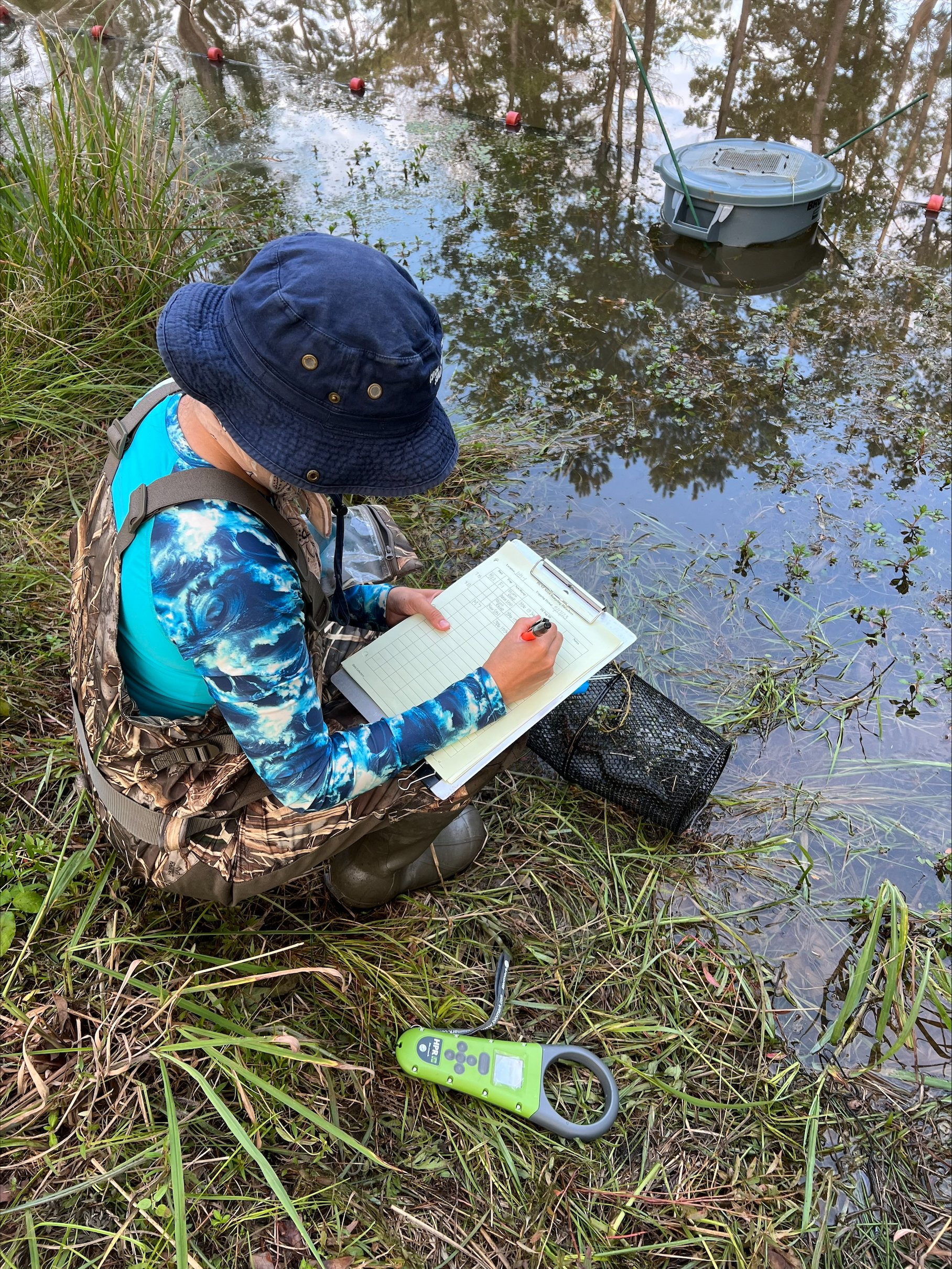
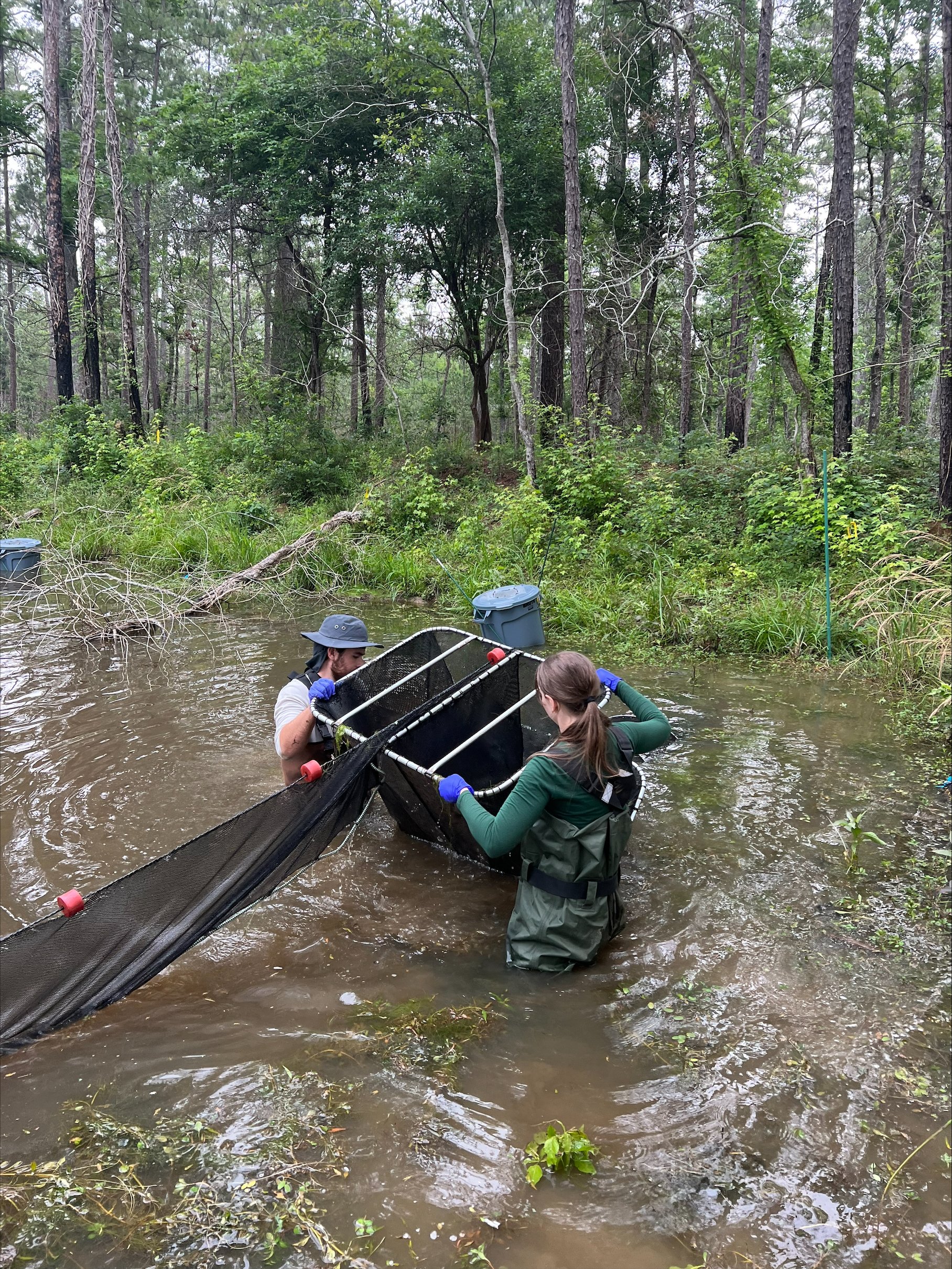
The project will track four populations of juvenile lesser sirens in Eastern Texas within and across years. Sirens’ health is directly affected by their environment through the impacts of resource availability on body condition and growth rates. Furthermore, sirens show strong size-dependent and seasonal shifts in antagonistic behaviors, which lead to acute injuries. This project will use water-borne corticosterone release rates to investigate changes in stress physiology as a function of changes in the environment experienced by the individual (population density, drought severity index, water temperature, pH, conductivity) across time and space to understand coping capacity. This data will also be used to investigate the welfare impact of an established marking technique compared to a novel machine-learning approach.
Grantee: Tom Luhring
Institutions: Wichita State University, Texas State University, and Stephen F. Austin University, United States
Project start date: October 2022
Grant amount: $162,604
Grant type: Challenge grants
Focal species: Sirens (Siren intermedia)
Conservation status: Least concern
Disciplines: Herpetology, physiology, climate science
Research location: United States
Project summary
The project will track individual juvenile lesser sirens (Siren intermedia) within and across years for four populations in Eastern Texas. The lack of a terrestrial life-stage and severely limited overland dispersal ability means that hydrologically isolated pools function as closed populations, facilitating recaptures and simplifying demographic estimates. Siren health is directly impacted by the effects of the environment (e.g., drought conditions) through the impacts of resource availability on body condition and growth rates. Furthermore, sirens show strong size-dependent and seasonal shifts in antagonistic behaviors such as biting which lead to acute injuries.
Aquatic amphibians are especially well-suited for the collection of water-borne stress hormones (corticosterone), which offer the least invasive method of evaluating an integrated measure of corticosterone levels that are passively being released through the skin, gills, feces, and urine. This project will use water-borne corticosterone release rates to investigate changes in stress physiology as a function of changes in the environment experienced by the individual (population density, drought severity index, water temperature, pH, conductivity) across time and space to understand coping capacity. These data will also be used to investigate the welfare impact of an established marking technique compared to a novel approach based on pattern recognition by a machine-learning algorithm.
Why we funded this project
Juvenile mortality is especially high in amphibians, and amphibian welfare in general is a neglected subject. This project should provide proof of concept for a cost-effective approach for assessing welfare at both an individual and population level. The waterborne measurements have the potential to integrate corticosterone over a longer period of time, increasing its reliability as a welfare indicator. Finally, this project will test a novel, non-invasive approach to mark-recapture studies, which could facilitate much better individual-level welfare research for amphibians and other (especially aquatic) animals in the future.